
On December 24, Ukrainians celebrate Christmas Eve — one of the most important Orthodox holidays that precedes the Nativity of Christ. On this day, families gather around the festive table, following ancient traditions passed down from generation to generation.
Didukh and Twelve Lenten Dishes
The main attribute of Christmas Eve is the Didukh — a straw sheaf that the head of the household ceremoniously brings into the home and places in a place of honor. This symbol embodies the family's prosperity and the connection between generations.
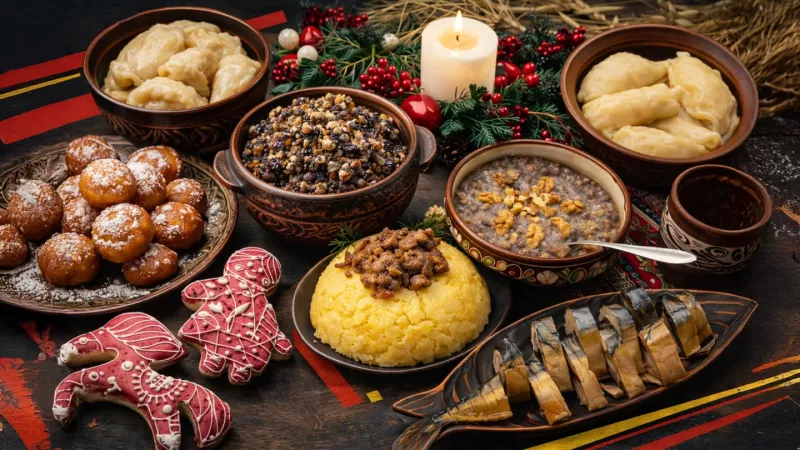
The Holy Evening traditionally consists of twelve lenten dishes, each with deep meaning. The central place is occupied by kutia — a symbol of eternal life and family unity, with which the meal begins. Among other mandatory dishes: uzvar, lenten borscht, fish, pampushky, vareniki, mushrooms, porridge, holubtsi, and kalach.
Linguistic Traditions: Correct Ukrainian Name
Linguists remind about the importance of using the correct Ukrainian name for the holiday. In Ukrainian tradition, this is Sviatvechir, not "Sochelnik" — a word that is a calque from Russian and does not belong to Ukrainian linguistic heritage.
According to experts, "Sochelnik" comes from the Russian "sochivo," while Ukrainians have their own authentic word — Sviatvechir, which emphasizes the sacredness of the moment and the anticipation of Christmas.
Regional Features of the Festive Table
Different regions of Ukraine have their own peculiarities in preparing Christmas dishes. In Transcarpathia they prepare korochun, in Volyn — special types of pampukhs, in Galicia and Slobozhanshchyna — their own variations of shcherba. The foundation remains unchanged: twelve lenten dishes using flour, grains, fish, and legumes.
Spiritual Traditions of the Evening
During the festive dinner, hosts leave spoons on the table for the souls of deceased relatives or travelers, demonstrating boundless hospitality and respect for their roots. When the dinner is ceremoniously placed on the table, the host greets those present with the words: "God grant, good evening!", to which the family responds: "God grant health!".
The quiet evening gradually grows into a solemn celebration when the first Christmas carols sound outside the windows, announcing the birth of Jesus Christ. These ancient songs become the culmination of the evening, uniting entire communities in common faith.