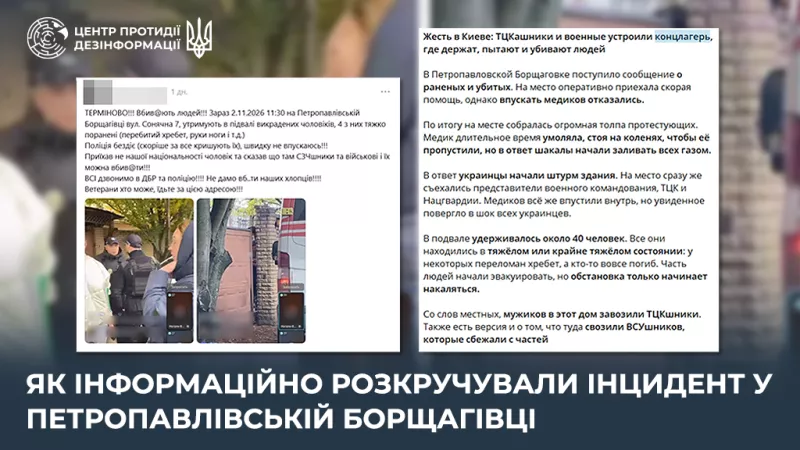
An incident in Petropavlivska Borshchahivka, Kyiv region, involving clashes between civilians and military personnel, was accompanied by a large-scale information campaign. Ukraine's Center for Countering Disinformation (CCD) under the National Security and Defense Council identified signs of coordinated dissemination of false information and possible external interference.
According to the Center's analysis of the information environment, Russian propaganda outlets and pro-Russian commentators attempted to exploit public outrage to generate negative attitudes toward Ukraine's Defense Forces, law enforcement agencies, and government authorities.
CCD analysts reconstructed the timeline of information activity on November 2:
- 11:34 AM — The first public call to gather near the building where the conflict was unfolding appeared on the social media platform Threads.
- 12:41 PM — Claims began circulating that approximately 40 people were allegedly being held in the basement of a building.
- 1:57 PM — Russian propaganda outlets began actively amplifying the story. One of the first to publish the claims was the Ukraina.ru channel, followed by similar reports across other platforms.
- 2:00 PM — A wave of nearly identical posts appeared across social media. Analysts identified 361 Facebook posts containing standardized claims that people were allegedly being detained and denied access to medical assistance.
- 3:21 PM — Pro-Russian commentators, including individuals previously sanctioned by Ukraine, joined the information campaign.
- Around 7:00 PM — A total of 110 Russian Telegram channels began spreading messages promoting the same narrative about alleged mass unrest among Ukrainians.
Researchers paid particular attention to the use of emotionally charged and radical language. Some of the circulating messages contained false claims that were subsequently refuted by law enforcement authorities.
Furthermore, according to the CCD, individuals who had previously participated in attempts to organize protest activities aligned with Russian propaganda interests were also involved in amplifying the incident.
The Center believes that the nature and sequence of the information dissemination may indicate a pre-planned information campaign involving possible external interference.
According to analysts, the primary objectives of this activity may have been to increase social tensions, discredit Ukrainian military personnel, and undermine public trust in state institutions.
The Center for Countering Disinformation urges citizens to critically evaluate sensational reports, verify original sources, and avoid sharing unconfirmed information.
Source: Center for Countering Disinformation under the National Security and Defense Council of Ukraine